
ArticlesAI & What's Next
When AI Makes Things Easy, What Happens to the Learning?
It's never been easier to find answers. But does that mean we're learning more?
Listen to this article
Voice
Uses your device's built-in voice
Bolds the start of each word to guide your eyes.
I love using AI to learn new things. I use Gemini regularly, and one of my favourite tools is NotebookLM.
When I’m studying a subject in detail for college, I can upload my course materials, research and other sources into NotebookLM. Then I can ask questions, explore different ideas and follow the links back to the original material. I can see where the information comes from, check it and make connections between sources.
It’s a way of studying that I really enjoy.
But I recently came across an interview with Andrew Ng that made me think about something. He was talking about how AI can help us get things done without us necessarily learning how to do them.
And he’s now building a company to address that very problem.
So what’s the difference between using AI to get an answer and using it to actually learn?
Andrew Ng thinks there’s a problem
Andrew Ng is an AI researcher and educator who co-founded Coursera and helped establish Google Brain. He’s spent years making education more accessible, so I was interested to hear his thoughts on this.
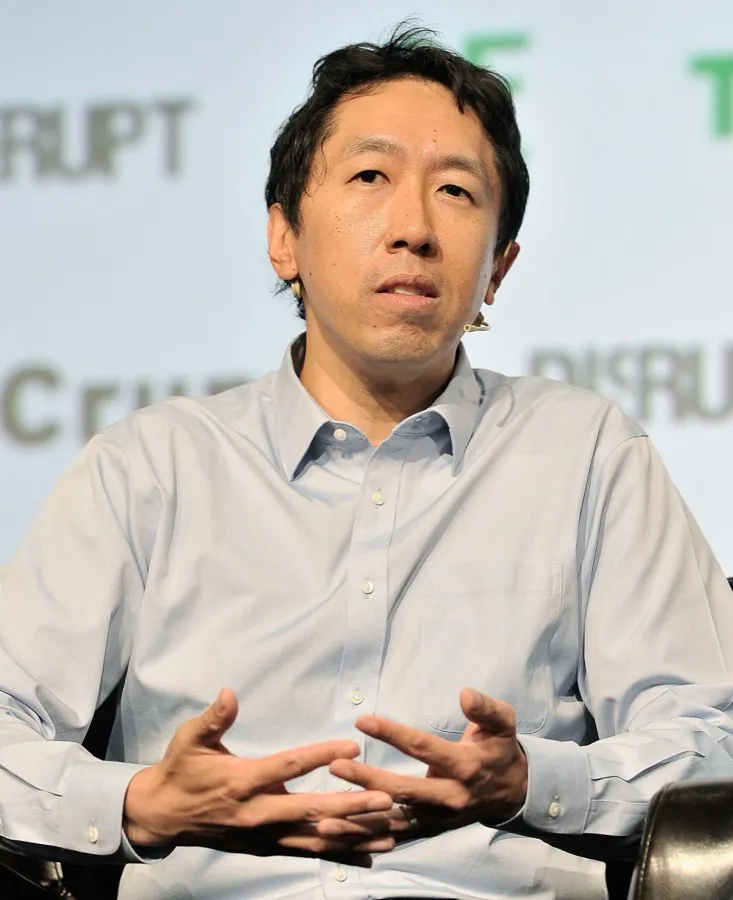
In an August 2026 interview with Marina Mogilko, he said something I hadn’t expected from someone so enthusiastic about AI.
He believes the way most people currently use AI is actually terrible for learning.
He gave an example from his own work. He might ask AI to help solve a programming problem, get everything working and move on. But six months later, when he needs to do something similar, he can’t remember how the solution worked.
So he asks AI again.
That’s the interesting part. The work got done, but did he actually learn how to do it?
Researchers call this cognitive offloading. Basically, we’re letting AI do some of the thinking for us.
And that isn’t necessarily a bad thing. We use tools to make work easier all the time. But if our goal is to learn a skill, having the answer handed to us might mean we miss the part that helps us understand and remember.
There is research suggesting that this can happen.
The students who did better with AI, until it was taken away
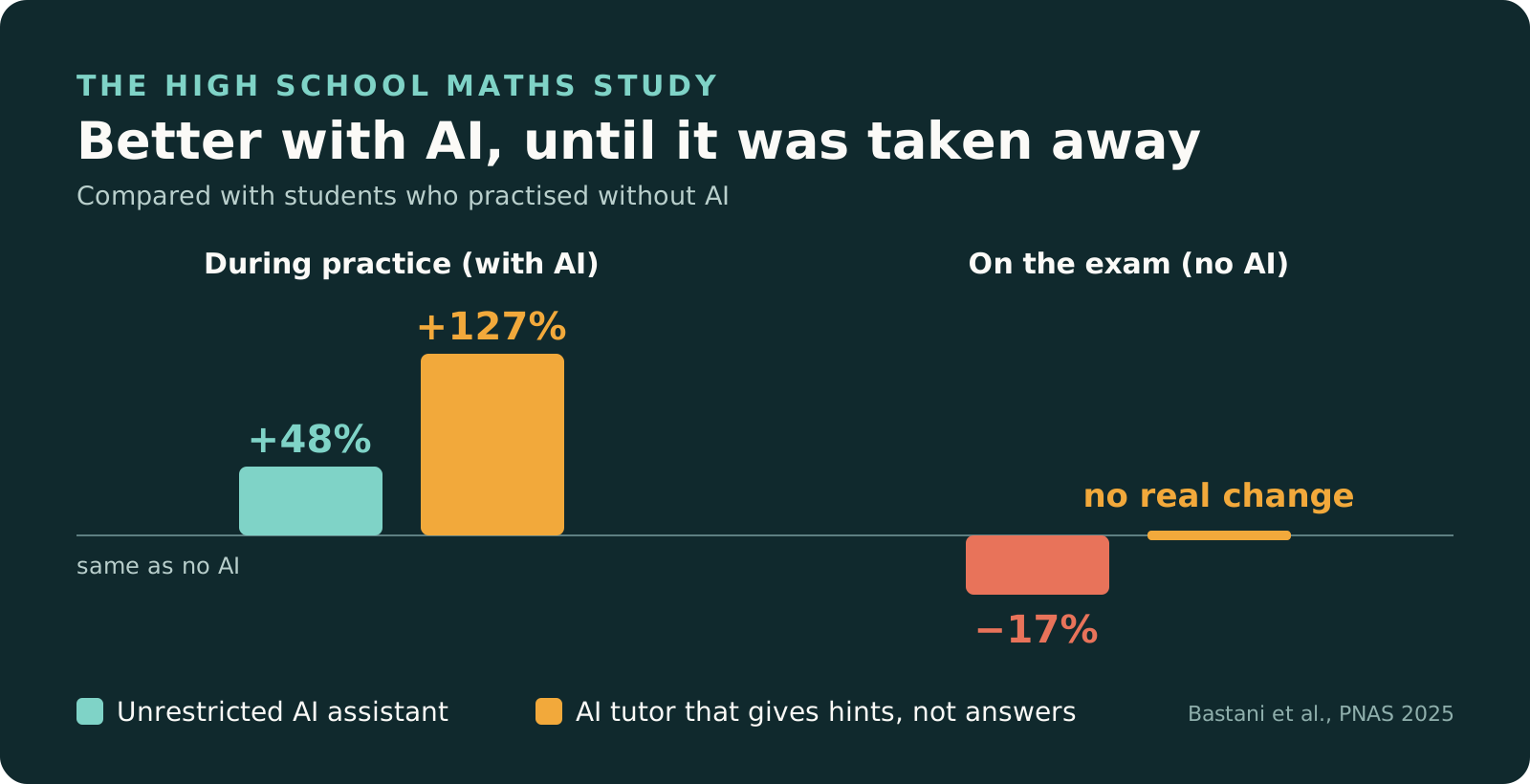
In 2025, researchers published a study involving nearly 1,000 high school mathematics students.
Some students worked with an AI assistant similar to ChatGPT. Others used a version designed to guide them through problems with hints rather than simply give them answers. A third group worked without AI.
During practice, the students using AI performed better.
That sounds promising, doesn’t it?
But when they had to take an exam without AI, the students who had used the more unrestricted assistant scored 17% lower than those who hadn’t used AI.
The students who used the version designed to guide their learning didn’t show the same statistically significant decline.
The researchers found that some students were relying on AI-generated solutions instead of working through the problems themselves.
Of course, this was one study involving high school mathematics. It doesn’t mean AI is bad for every kind of learning.
But it does show that there’s a difference between doing well with help and understanding something well enough to do it yourself.
And it raises another question. Could we design AI to help us learn better, rather than simply making everything easier?
What Andrew Ng is building now
This is what Ng is working on with his new company, LearnVector.
In July 2026, Coursera announced a $100 million investment in the company. The idea is to develop more personalized learning experiences using AI.
Think about a typical online course. Everyone watches the same videos and works through the same lessons, even though people have different backgrounds and learn at different speeds.
What if an AI tutor could understand what you already know, recognize where you’re struggling and help you practise until you really understand something?
Instead of simply answering a question, it could give you a hint, ask you to try again or explain the same idea in a different way.
That’s what LearnVector is aiming to build. Its first learning experiences are expected in early 2027, so we’ll have to see how well the approach works.
I like the idea that AI could make this kind of personal attention available to more people.
And we’re already seeing some of these possibilities in tools we can use today.
How I use NotebookLM to study
Google recently renamed NotebookLM to Gemini Notebook, although I still tend to call it NotebookLM.
I’ve been using it to study subjects in more detail, especially when I have a lot of college material to work through.
I can bring my sources together in one place and ask questions about them. One thing I particularly appreciate is that it shows me which sources it used to produce an answer.
I can follow those references, read the original information and see how different ideas relate to each other.
That’s important to me because I don’t want to simply accept whatever AI tells me. I want to understand it, and I want to be able to check where the information comes from.
Of course, having links to sources doesn’t guarantee that an explanation is correct. AI can still misunderstand something or make a connection that isn’t supported by the material.
But having the original sources available makes it much easier to check.
NotebookLM can also create quizzes and flashcards from your materials. And Gemini has a Guided Learning feature designed to work through questions with you instead of immediately providing the answer.
Imagine studying something complicated and having a tool that can explain it in different ways, help you review what you’ve learned and let you explore a subject as deeply as you want.
I think that’s a wonderful opportunity.
And it isn’t just about formal education.

I’ve been learning the ukulele, and I’ve even worked with Claude on an idea for a 3D-printable learning aid. I love being able to explore ideas like that with AI.
But AI can’t practise the ukulele for me. I still need to learn how to position my fingers, change chords and play.
That distinction matters. Sometimes we’re using AI to get something done. Other times, learning how to do it is the whole point.
What if AI helps us connect knowledge in ways we couldn’t before?
There’s something else about AI and learning that I think could be even more important.
As humans, we’re limited in how much we can learn and remember. We tend to become knowledgeable in certain areas, and even people who spend their lives studying a subject can’t possibly know everything.
Scientists and researchers specialize too. Someone might spend years studying marine biology, while someone else is researching materials, medicine or engineering.
There’s an enormous amount of knowledge spread across all these different fields.
What if AI could help us connect more of it?
Imagine researchers studying the oceans being able to explore findings from chemistry, engineering and other sciences that they might not otherwise have come across.

Or someone working on an environmental problem discovering that researchers in another field have already developed an approach that could be useful.
AI can work with large amounts of information and help identify possible connections. That doesn’t mean every connection it suggests will be meaningful or correct. We still need people with the knowledge and experience to investigate those ideas.
But it could give us new starting points.
I’ve worked with ocean scientists and studied environmental subjects, so I particularly enjoy thinking about what this could mean for science and the environment.
We already know so much, but much of that knowledge sits in separate fields, institutions, publications and people’s minds. Bringing more of it together could help us understand things differently.
And for someone like me, who enjoys learning about many different subjects, that’s one of the things I love about AI. It lets me explore beyond the areas I already know.
I don’t believe we need to become experts in everything. But perhaps we can become better at understanding how different things connect.
So, is AI making us better learners?
After looking at Andrew Ng’s interview and the research, I think there’s a real difference between using AI to finish something and using it to develop our own understanding.
Sometimes we just need to get a task done. There’s nothing wrong with using AI to help us work faster.
But when I want to learn something, I don’t want AI to do all the thinking for me. I want to ask questions, explore the material, understand how things work and be able to remember what I’ve learned.
That’s why I enjoy tools like NotebookLM. I can use AI to help me work through information while still going back to the sources and forming my own understanding.
And I think the possibilities go much further.
We’re only beginning to explore what happens when people can learn across different subjects, connect research and build on knowledge that would previously have been difficult to access.
I don’t see AI as a replacement for human learning. I see it as something that could help us learn and discover much more, provided we use it well.
Perhaps the real opportunity isn’t just that AI can give us answers. It’s that it could help us ask better questions, understand more and make connections we might otherwise have missed.
Was this useful?
Sources and further reading
- Andrew Ng interviewed by Marina Mogilko: The Biggest Opportunities in AI Aren't Where You Think (August 28, 2026) (opens in a new tab) · Ng discusses why using AI to complete tasks can interfere with learning, shares his own experience and explains the thinking behind LearnVector.
- Coursera: $100 Million Strategic Investment in LearnVector (July 28, 2026) (opens in a new tab) · The official announcement of Ng's new AI learning company, its planned approach and its expected early-2027 launch.
- Bastani and colleagues: Generative AI Without Guardrails Can Harm Learning: Evidence from High School Mathematics (PNAS, 2025) (opens in a new tab) · The study involving nearly 1,000 high school mathematics students, comparing an unrestricted AI assistant with one designed to support learning.
- Google: Guided Learning in Gemini (August 2025) (opens in a new tab) · An explanation of Google's learning experience designed to help people understand concepts rather than simply receive answers.
- Google: NotebookLM Is Now Gemini Notebook (July 2026) (opens in a new tab) · The official announcement of the name change and the product's continuing focus on research and learning.
- Google: Use Chat in Gemini Notebook (sources and citations) (opens in a new tab) · Explains how the tool uses uploaded material and provides citations that let users check answers against original sources.
- Google: 3 New Study Features in Gemini Notebook (October 2026) (opens in a new tab) · An overview of quizzes, flashcards, interactive learning materials and other study features.